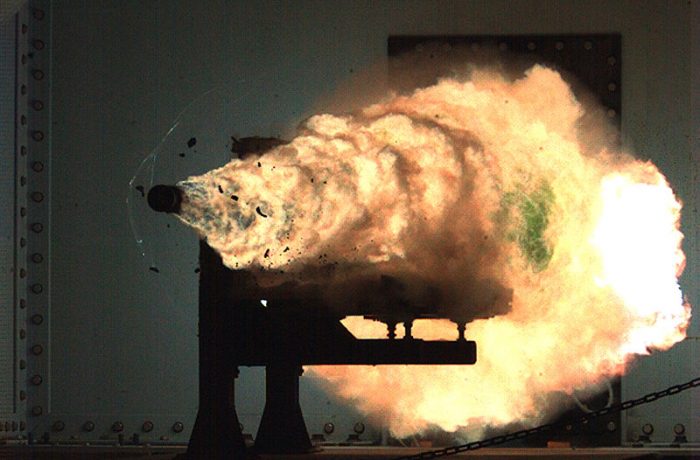
SITUATION: As part of a DARPA funded project, JHUAPL was required to develop an engineering analysis of an under-actuated version of a hyper velocity guided projectile. The concern was that the fin actuators needed to be large enough to both meet mission requirements and launcher dimensions. However, to do so an analysis 2 fins would need to be removed from the typical 4-fin guided projectile so that more room could be made internally to house the more powerful yet larger fin actuators. Given an under-actuated guided projectile, would mission requirements still be met?
TASK: In order to answer this question, the task was generated that to construct a controller or autopilot that both maintained stability vehicle stability during flight (especially as it exited the launcher where tip-off rates are high) and met the lateral acceleration requirements for mission maneuverability.
ACTIONS: Given a nonlinear mathematical model of the projectile aerodynamics based on wind tunnel tests, the model was linearized to generate the aerodynamic coefficients of lift, drag, side-force and the moment coefficients of roll, yaw and pitch required by the typical 3-loop autopilot structure. In typical skid-to-turn autopilots for fully actuated guided projectiles, the assumption is usually made that no cross-coupling of dynamics occurs between the roll, pitch and yaw projectile vehicle body axes due to mission requirements and the ability of the 4-fins to independently affect the roll, pitch and yaw motion of the projectile. However, with the projectile being under-actuated and only 2 fins available to affect the roll, pitch and yaw motion dynamic cross-coupling could no longer be ignored.
RESULTS: 6-DOF Monte Carlo simulation results showed that the newly designed bank-to-turn autopilot allowed the projectile to be much more maneuverable over the standard 3-loop skid-to-turn autopilot performance allowing for the achievement of high angles of attack needed to maintain mission requirements while still using a 2-fin projectile configuration.
Photo courtesy U.S. Navy