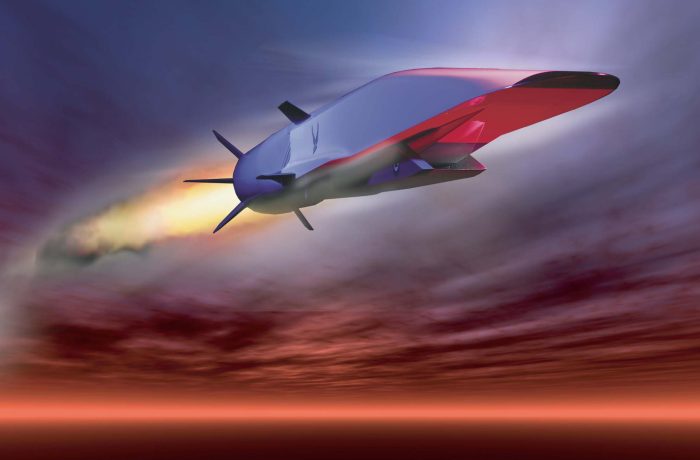
SITUATION: The client Leidos was performing work for the Air Force who was interested in maturing the technical readiness of a hypersonic weapon to meet the threat posed from overseas. Though hypersonic technology had been around for several decades its use in a weapon was unknown and much uncertainty lay in its use. There were two types of vehicles being considering: a boost then glide vehicle and a scramjet powered vehicle.
TASK: Develop a vehicle controller or autopilot that could stabilize and meet the maneuver requirements of the mission. Due to the high uncertainty in the models of the hypersonic vehicles available the autopilot needed to be robust enough to withstand large unknowns in the vehicle models.
ACTIONS: Aerodynamic models of both the glide and scramjet powered vehicle in the form of force and moment coefficients were obtained from the client and placed into a government furnished Matlab/Simulink 6-DOF hypersonic vehicle simulation. the scramjet powered vehicle model contained additional data due to the high degree of coupling between the scramjet and vehicle body. Mathematical development of the autopilot was performed such that vehicle kinematic state measurement feedback was used to remove known vehicle nonlinearities and linear control theory was used to increase robustness of the controller. The scramjet powered vehicle autopilot had an additional feature for throttling on and off the scramjet to meet mission speed requirements. The autopilots for the two vehicle types were coded into the government furnished 6-DOF simulation and Monte Carlo results were generated once the guidance algorithms were in place.
RESULTS: Simulation results showed that the autopilots successfully controlled the vehicle with parameter variations of upto 20% off nominal. The scramjet powered vehicle autopilot was robust enough to withstand the drastic change in vehicle model when angle-of-attack limitations were breached due to maneuver requirements that would cause the scramjet to unstart. Additional results showed that the autopilot could control the vehicle such that the scramjet could be restarted during flight after it had unstarted.